

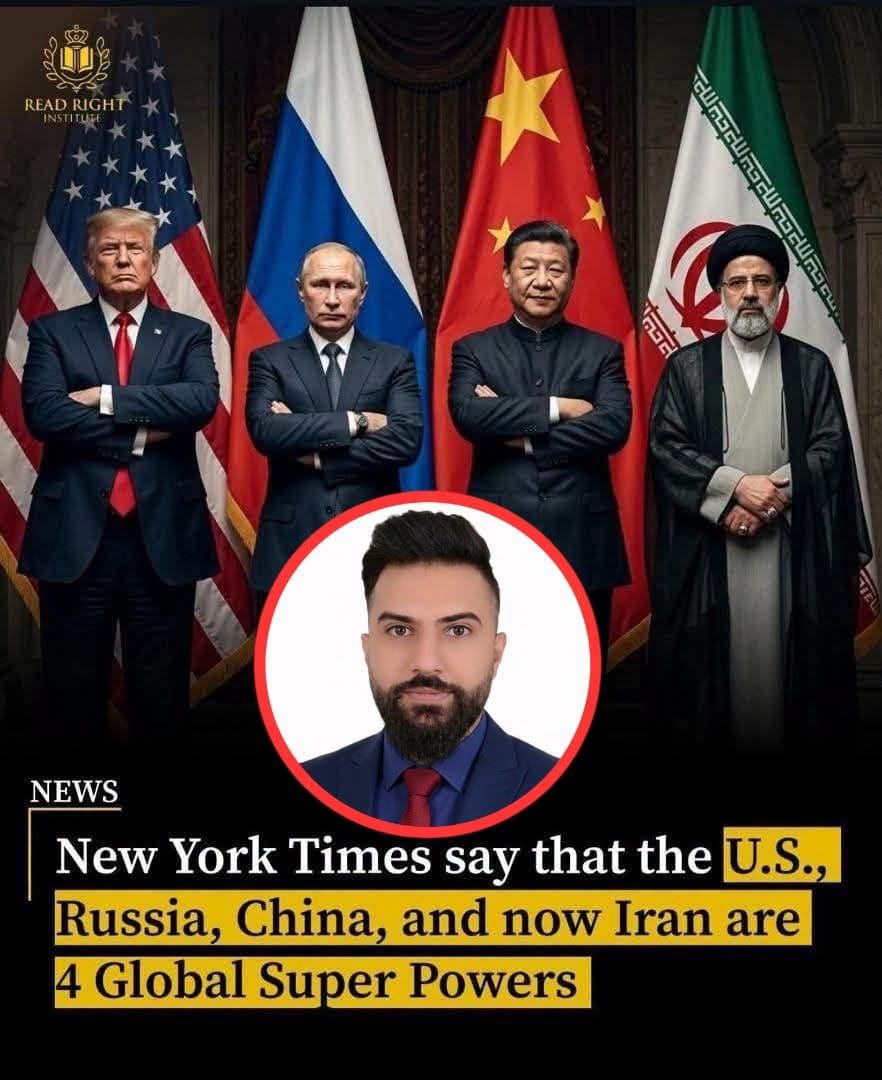

Iran Shatters the Prestige of the Unipolar Power… and Emerges from the Heart of the Confrontation with America as the Fourth Global Power… While Europe Seeks Negotiations with Tehran *By: Ali Jaafar Al-Bandar*
The newspaper The New York Times published an article titled “The Four New Great Powers (America, Russia, China, and Iran).” Yesterday *Germany, Britain, and France* announced their readiness to negotiate with *Iran*. This shift came to cover up *Trump’s failure* and his inability to achieve any of his declared objectives, all of which everyone knew, the latest being “unconditional surrender,” in his war against *Iran*. This is despite his use of all the immense power possessed by the *American arsenal*. Trump himself also said two days ago: “I have once again asked the NATO countries to help us in our war against Iran, but they refused.” After *Trump* claimed for the 1,213th thousandth time that he had opened and taken control of the Strait of Hormuz, with oil flowing out and the passage of ships and oil tankers secured at pre-war levels, he turned to *Putin*, despite the *American sanctions* imposed on *Russia* and Russian oil and energy companies, to purchase petroleum products, specifically diesel. He is desperately trying to compensate the global markets, which have been exposed to major crises due to the inability to provide energy and the rise in prices. The price of a single barrel of oil has exceeded the $117 threshold because of *Iran’s control over the strait*. This indicates that *Trump and his administration are experiencing the worst state of confusion in their decision-making* and still do not know what they should do to extricate themselves from the predicament into which *Iran* has thrown them. Now, *Europe*, speaking through the German foreign minister on behalf of the “European troika,” is turning to *America’s arch-enemy, Iran*, for negotiations. It is striving to compensate for what it has lost in its oil and gas markets, supplied through the Strait of Hormuz, before the Old Continent freezes, shuts down what remains of its factories serving importers from countries around the world, and takes its final breath, becoming a dead continent due to its inability to sustain industrial production—a continent that once sat on the throne of the world as an economic power. *Iran is no longer, in international political calculations, merely a country facing sanctions or standing in confrontation with the United States and its allies.* Rather, it has become one of the most prominent issues exposing the limits of *American power* and a genuine test of its ability to manage major crises and impose its will as an invincible superpower on other countries, such as *Iran*. We are witnessing a historic shift in the global balance of power. A crisis has revealed to us that *American influence over the world, particularly the Middle East, is no longer what it once was.* The readiness of *Germany, Britain, and France* to engage in a negotiating process with Iran raises a genuine question: *Have Europe and America submitted to Iran’s power?* Europe, which has grown accustomed to aligning itself with the American system in all its wars, now finds itself facing an extremely complex equation: How can it preserve its alliance with Washington while, at the same time, protecting its economic interests and energy security from the consequences of America’s failed war against Iran? A war in which America achieved none of its objectives, but which instead made Iran more powerful and more steadfast in its positions, enabling it to impose conditions and now control one of the most important waterways in the world, through which more than 40% of global energy supplies pass.